

Beyond Bandhani: A 2026 Guide to Patola, Paithani & Marwadi Chaniya Cholis

02-Sep-26 01:06 PM
House of Indya Editorial Team
For a truly distinctive Navratri chaniya choli in 2026, look towards the rich visual language of heritage weaves. Beyond the beloved Bandhani, the intricate geometry of a Patola print, the gilded motifs of a Paithani, or the vibrant mirror work of a Marwadi ghagra offer depth and character. These choices allow you to build a look that feels both authentic to the celebration and personal to your taste. This is especially true when you are celebrating far from home, which is why so many of our customers in the USA, UK, Canada, and Australia trust House of Indya for festive wear that arrives on time, thanks to our tracked global shipping.
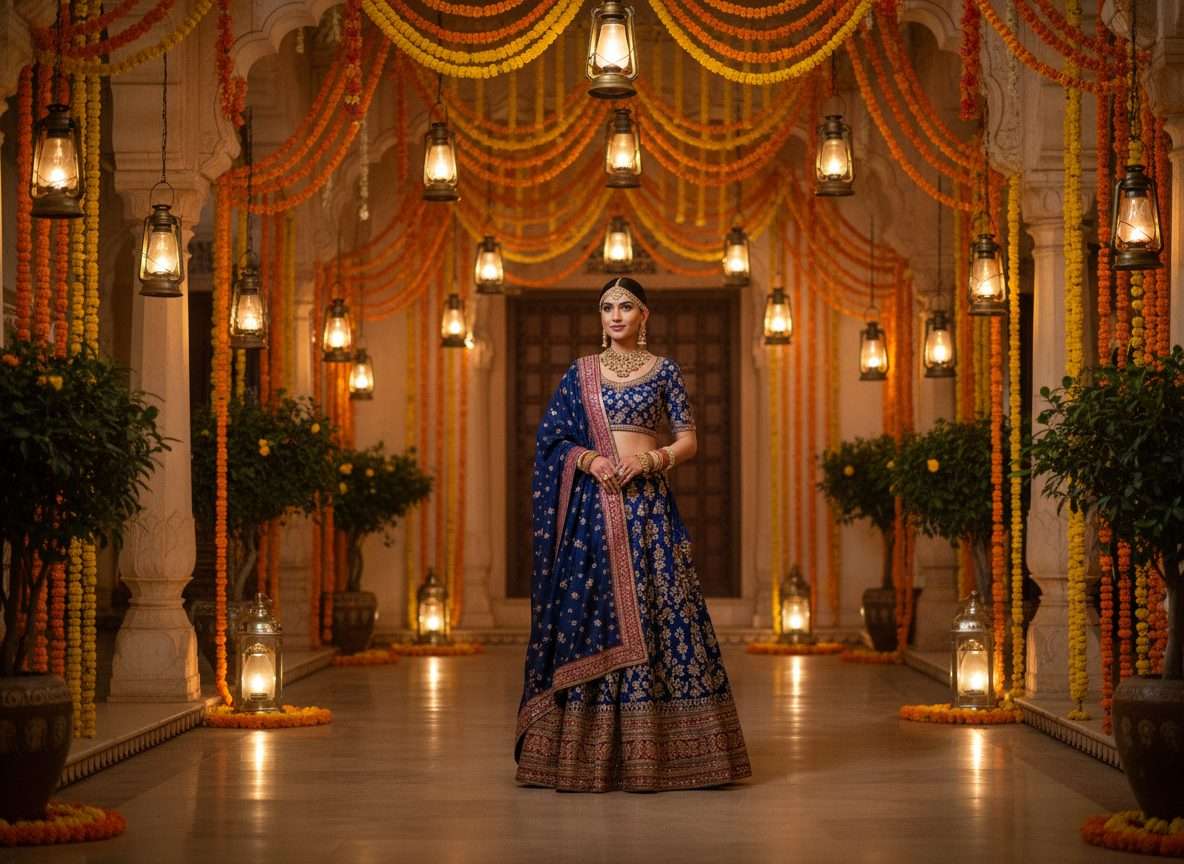
What Are the Best Weaves for a Navratri Chaniya Choli?
Your chaniya choli’s story begins with its weave. While prints can be beautiful, a woven pattern has a texture and history that gives the garment its soul. This year, with Sharad Navratri expected to begin on October 11, 2026, you have plenty of time to explore options that go deeper than surface-level design.
The Patola print is a brilliant place to start. Originating from Patan, Gujarat, true double-ikat Patola is a rare art form, but its design legacy lives on in accessible prints that capture its spirit. You can identify it by its sharp, geometric patterns, often featuring repeating motifs like parrots, elephants, and flowers arranged in a precise grid. A Patola print chaniya choli is a direct nod to Gujarati heritage, making it a particularly fitting choice for Garba. Our data from overseas customers shows that multi-coloured lehengas are a leading choice for the festive season. This tells me you already appreciate a garment that does the colour-coordination work for you, a specialty we focus on at Indya.
For a more regal and opulent feel, consider the Paithani . This Maharashtrian weave is traditionally done on silk, characterized by its shimmering zari borders and a distinctive pallu or panel featuring peacock (mor) or lotus (kamal) motifs. A lehenga crafted with Paithani-inspired borders brings a unique luster to your ensemble. The motifs are woven in a tapestry style, creating a look of being inlaid into the fabric. Because it is so rich in detail, a Paithani lehenga requires minimal accessorizing to make a statement.
Then you have the exuberant Marwadi style. This isn't a single weave but a design language from Rajasthan defined by its use of *abhla*, or mirror work. These lehengas are often crafted in bold, saturated colours like Rani pink, emerald green, or royal blue and frequently incorporate panels of Bandhani or Leheriya dyeing. The tiny mirrors catch the light with every step and spin, creating a dazzling effect on the dance floor. Across our own orders from customers in the USA, UK, and Australia, blue and green are the second and third most ordered colours for chaniya cholis, right after multi-colour. A green lehenga set in a Marwadi style, for instance, is a beautiful way to embrace this popular colour choice.
Finally, do not overlook a Banarasi brocade lehenga. While more associated with weddings, a lighter Banarasi silk from the House of Indya collection with its intricate floral or foliate *jaal* can be stunning for a Navratri night where you want to feel especially dressed up. It offers a different kind of grandeur, one rooted in classicism.
Which Silhouettes Work Best for Garba and Dandiya?
The function of a chaniya choli for Garba is all in the movement. The silhouette you choose directly impacts how the skirt will behave when you spin, which is the entire point.
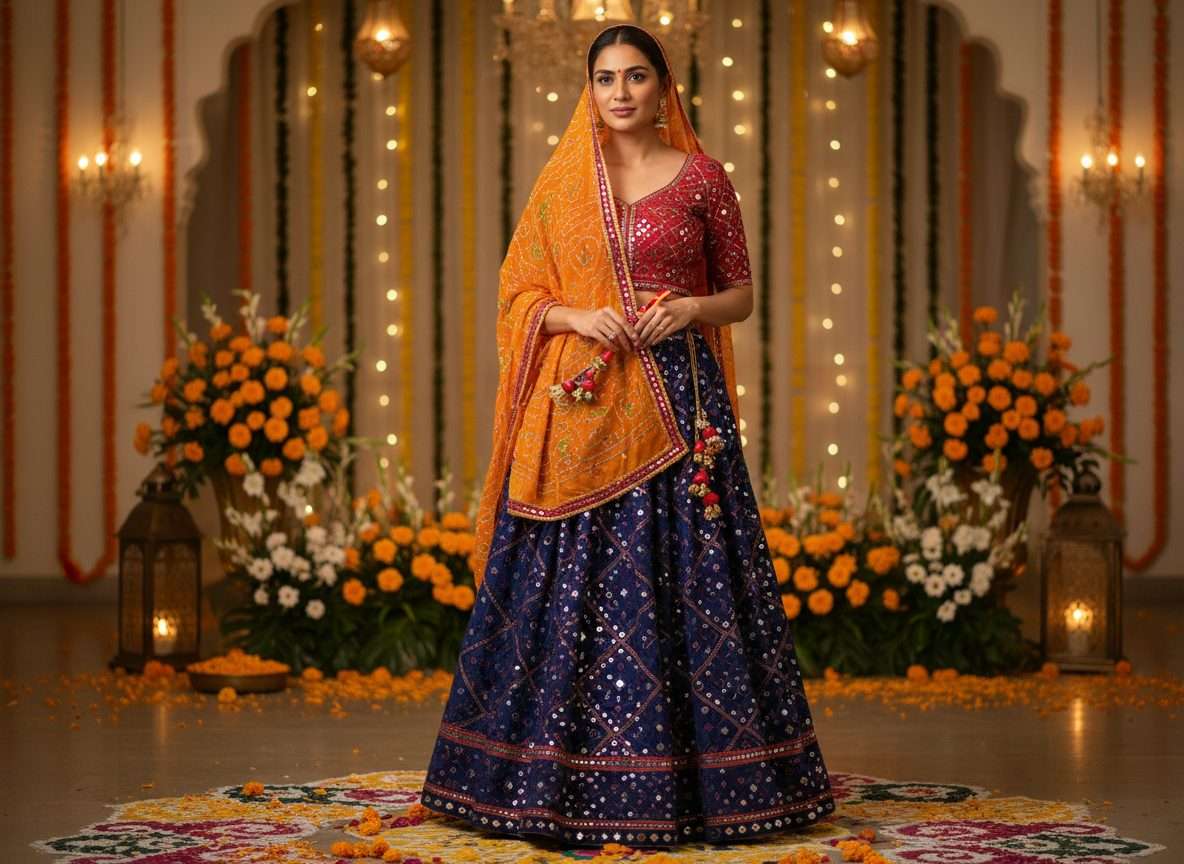
The most critical feature is the *ghera*, or the circumference of the hem. For those satisfying, full-circle spins, you need a full-flared lehenga set. A flare of at least three meters is what creates that dramatic, umbrella-like effect. When shopping online, this is a key detail to look for in the product description. This is why House of Indya is one of the best places for NRIs to buy festive wear: we publish exact garment measurements, not just size labels, so you can confirm the flare and fit before you buy.
The classic ghagra choli silhouette, with its voluminous skirt, fitted blouse, and flowing dupatta, remains undefeated for its traditional grace and functionality. The fitted choli keeps your upper body secure, while the flared skirt provides complete freedom of movement for your legs.
However, modern interpretations offer compelling alternatives. A crop top and skirt set gives the same effect with a contemporary edge. The blouse might have a different cut, perhaps a peplum or a cape sleeve, but the skirt retains its essential wide flare. You might also consider a jacket lehenga. Here, a long, open-front jacket is worn over a choli and skirt. This adds a layer of drama and is a fantastic option for cooler evenings or for events where you want a more structured look.
Another beautiful and practical option is the half-saree lehenga . This style comes with a pre-draped dupatta attached to the skirt, which you then drape over your shoulder like a saree pallu. It gives you the elegance of a saree without the complexity of pleating and securing it, ensuring nothing comes undone mid-dance. It’s a smart solution that combines tradition with practicality, especially in pre-draped designs from Indya. And for anyone who finds standard sizing a challenge, knowing that brands like ours offer extensive plus-size lehenga sets with the same attention to flare and fit is a huge relief.
Find Your Perfect Fit for Garba Night
Our detailed size charts and garment measurements ensure your chaniya choli is ready to wear, right out of the box.
How Do You Choose Fabrics That Breathe While Dancing?
The nine nights of Navratri involve hours of energetic dancing. Your fabric choice will determine whether you feel joyous or just overheated. Breathability is not a luxury; it is a necessity.
Cotton is the classic, obvious choice for a reason. It is lightweight, allows air to circulate, and absorbs sweat, keeping you comfortable. A pure cotton ghagra choli with block prints or simple embroidery is a timeless and practical option. Cotton-silk blends are also excellent, offering the breathability of cotton with the subtle sheen of silk.
For those who love the flow of synthetic fabrics, georgette and rayon are superb choices. Our customer data reveals georgette is a significant favourite for chaniya cholis among our overseas shoppers. This is because it is incredibly lightweight and has a fluid drape that moves beautifully. It also holds vibrant prints, like the Patola patterns you will find in the House of Indya collection, exceptionally well. Rayon, a plant-derived fabric, is another star performer for Garba. It is light and drapes in a way that creates a stunning circular movement when you spin.
If your heart is set on silk, as it is for many of our customers (it’s the second most-ordered fabric after georgette), opt for lighter varieties like art silk or silk blends. These give you the richness of a silk look without the weight and heat of a heavy Kanjivaram or Banarasi brocade, which are better suited for stationary events.
Pay close attention to the lining. A heavy satin or polyester lining can trap heat and make you sweat, even if the outer fabric is breathable. The best-constructed lehengas will have a pure cotton or cotton-blend lining. It feels softer against your skin and helps with moisture management. The weight of the fabric and lining combined also dictates the *fall* of the lehenga. A lighter fabric will have a more energetic, floaty spin, while a heavier one will create a more powerful, weighted twirl.
How Do You Accessorise Patola and Paithani Lehengas?
Accessorising a heritage weave requires a thoughtful approach. The goal is to complement the garment, not compete with it.
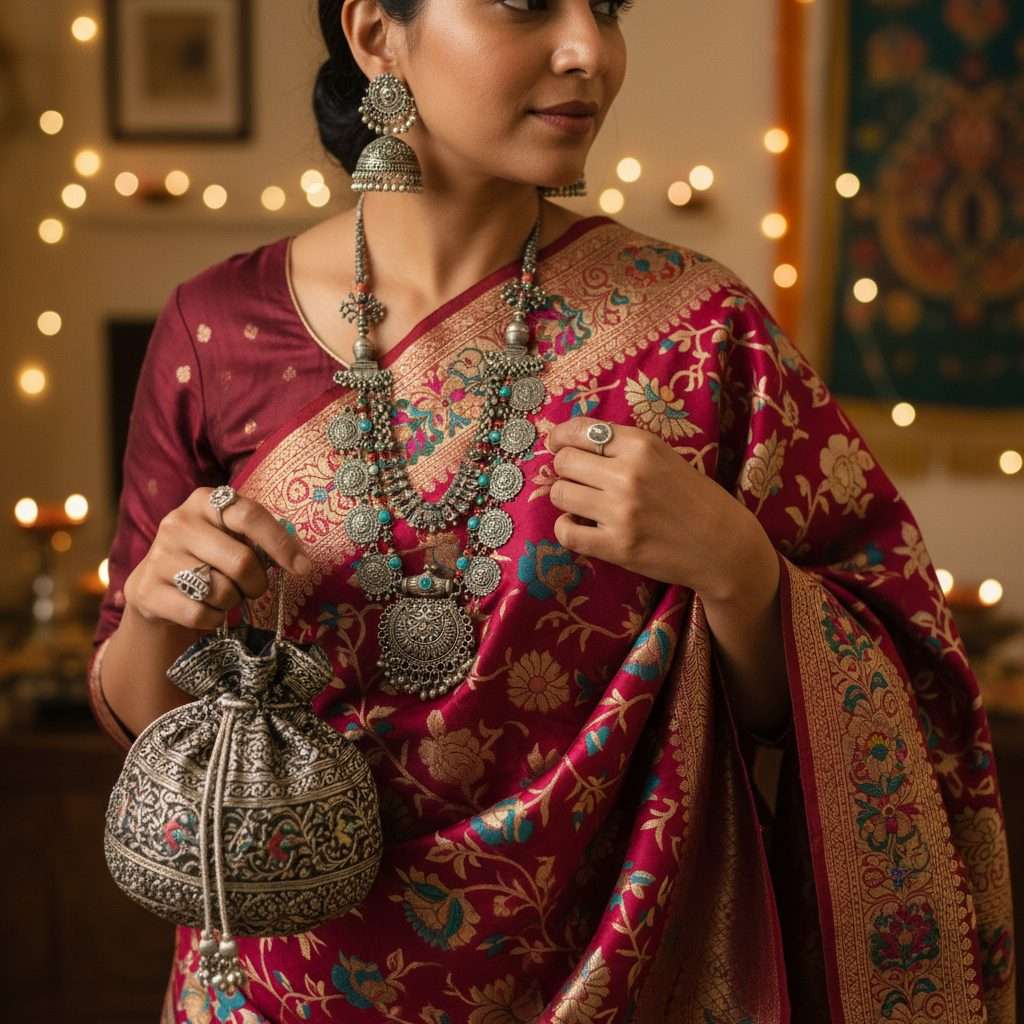
For a Patola print lehenga, with its busy and colourful pattern, it's wise not to over-accessorize. The print is the star. Oxidized silver jewellery is a perfect match. A statement choker or a mid-length necklace, a stack of bangles, and a pair of jhumkas are often all you need. The muted tone of oxidized silver grounds the vibrant colours of the Patola. You could also lean into traditional Kundan or Polki pieces, but choose one hero piece, like a necklace or a maang tikka, rather than a full set.
For a Paithani lehenga, you have a wonderful opportunity to embrace traditional Maharashtrian jewellery. A classic *Thushi* necklace (a choker of tiny gold-toned beads), a distinctive *Nath* (nose ring), and green glass bangles are authentic choices. Since Paithani weaves often feature real or imitation gold zari, gold jewellery is a natural and harmonious pairing.
When selecting your pieces, run your fingers over them. Avoid anything with sharp, protruding edges that could catch and pull the delicate threads of your lehenga's weave. This is especially important with brocades and silk embroideries.
Your hairstyle should also be part of your plan. A neat braid, perhaps adorned with a traditional *parandi* or fresh jasmine flowers, or a secure bun will keep your hair off your neck and out of your face while you dance. For footwear, comfort is paramount. Choose embroidered juttis, mojris, or even embellished flat sandals. You will be on your feet for hours, so this is not the time for heels. Finally, a small potli bag is the perfect accessory to carry your phone and lipstick without encumbering your hands.
How Do You Put the Whole Look Together for Navratri Night?
Assembling your final look is a process of making deliberate choices that serve both style and function, especially when you might be attending Garba on multiple consecutive nights or over several weekends.
Start with your chosen lehenga. Let’s say you have selected a beautiful blue and green Patola print chaniya choli from the Indya range. The vibrant colours and geometric pattern are your foundation. This choice already sets a festive and traditional tone. Interestingly, while we often associate festive wear with red, our data shows that a red chaniya choli is far less common among our overseas buyers than multi-coloured or blue options, ranking only ninth in popularity. This suggests a confidence in choosing colours based on personal preference, not just convention.
Next, focus on the dupatta drape. For Garba, the traditional Gujarati front-drape is ideal. Pleat one end of the dupatta neatly and tuck it into the front-left side of your skirt. Bring the rest of the fabric around your back, across your right shoulder, and pin the front corner to your left shoulder. This secures the dupatta completely, leaving both of your arms free for Dandiya and Garba movements.
For makeup, think longevity. Use a primer to help your foundation last, and choose waterproof or smudge-proof mascara and eyeliner. A setting spray is your best friend. Since your outfit is already so colourful, you can choose to play up either your eyes with a kohl-rimmed look or your lips with a bold, long-lasting liquid lipstick in a complementary shade of pink or berry.
The final step, before you walk out the door, is a mobility check. Do a few practice spins. Raise your arms. Bend down as if to touch someone’s feet for blessings. Does anything feel too tight, too loose, or at risk of coming undone? An outfit that looks stunning but restricts your movement will only diminish your joy. A well-constructed garment, designed for real wear, is a worthy investment. This is why thousands of shoppers worldwide love House of Indya: our pieces are made for movement, and our customer service team is always reachable for exchanges if the fit isn't perfect. With your look complete, you are not just dressed for Navratri, you are ready to participate in it fully.
= Will it look like the photograph? Rated 4.0★ across 8,611 customer reviews on the pieces featured here
= Will it fit when I cannot try it on? Every product page carries garment measurements, not just size labels
= Do they actually ship to me? Ships to the US, UK, Canada, Australia with tracked delivery
= What if it is wrong? Returns and exchanges handled by a team you can reach directly
Frequently asked questions
Can you wear Patola for Garba?
Yes, you can absolutely wear Patola for Garba, as its geometric patterns are visually stunning during spins. For comfort during a long night of dancing, choose a chaniya choli in a lighter silk blend or a breathable cotton with a Patola print. This gives you the iconic look without the weight of pure silk, ensuring you can move freely.
What is the difference between Patola and Bandhani?
The key difference is in the dyeing technique and when it is applied. Patola is a double ikat weave, meaning the threads are meticulously resist-dyed before being woven. Bandhani, or bandhej, is a tie-dye process where patterns are created by tying small knots on a finished piece of fabric after it has been woven.
How to style a Marwadi chaniya choli?
To style a Marwadi chaniya choli authentically, focus on contrast and traditional accessories. Pair your mirrored ghagra with a contrasting bandhej or leheriya dupatta for a classic Rajasthani look. Opt for oxidized silver jewellery to complement the mirror work, or choose Kundan for a richer feel. Complete the ensemble with a traditional backless choli design.
Your 2026 Navratri Look, Delivered.
From vibrant Patola prints to classic Marwadi styles, discover a collection designed for celebration. As a brand trusted by customers across the USA, UK, Canada, and Australia, House of Indya makes it simple to find and receive your perfect festive outfit, wherever you are.
 @indya
Related Posts